
In the high stakes world of Formula 1, the most critical battle is not just fought against other drivers on the track (it is fought against the air itself). While raw horsepower and driver reflexes often steal the headlines, the true dictator of a car’s success or failure is aerodynamics. It is an invisible, relentless force that engineers must meticulously harness to stick a car to the tarmac at mind bending speeds. But this mastery if fluid dynamics is a delicate, double edged sword: get it right, and you unlock unparalleled grip and cornering speed; get it wrong, and the very air meant to keep the air grounded can transform it into an unstable, high speed projectile. Understanding F1 aerodynamics is about more than just reducing drag it is about the precise, life saving balance of speed, control and survival.
Formula 1 Aerodynamics: Speed, Control and the danger of getting it wrong
When people watch a Formula 1 race, they often focus on speed, drivers, and overtakes. But behind every fast lap lies something invisible yet decisive: aerodynamics. In formula 1, air is not just something the car moves through, it is something engineers carefully control to generate grip, stability, and performance.
From an engineering perspective, aerodynamics belong to the field of fluid dynamics, where airflow behavior determines how forces act on the car. These forces can either push the car into the track, improving performance, or destabilize it, increasing the risk of accidents. That is why aerodynamics in Formula 1 is not only about speed, but also about control and safety.
The core concept: Downforce vs Drag
At the heart of formula 1 aerodynamics are two competing forces:
- Downforce: pushes the car toward the ground, increasing tire grip
- Drag: resists forward motion, reducing top speed
The goal of engineers is to maximize downforce while minimizing drag. This balance allows the car to corner at extremely high speeds while still being competitive on straights.
Downforce increases the normal force on the tires, which allows them to generate more friction.
This means:
- later breaking
- higher cornering speeds
- better acceleration out of turns
However, too much drag will slow the car down. That is why aerodynamic design is always a compromise depending on the track
Key Aerodynamic Components
A Formula 1 car is not defined by a single aerodynamic device, but by a system of components working together.
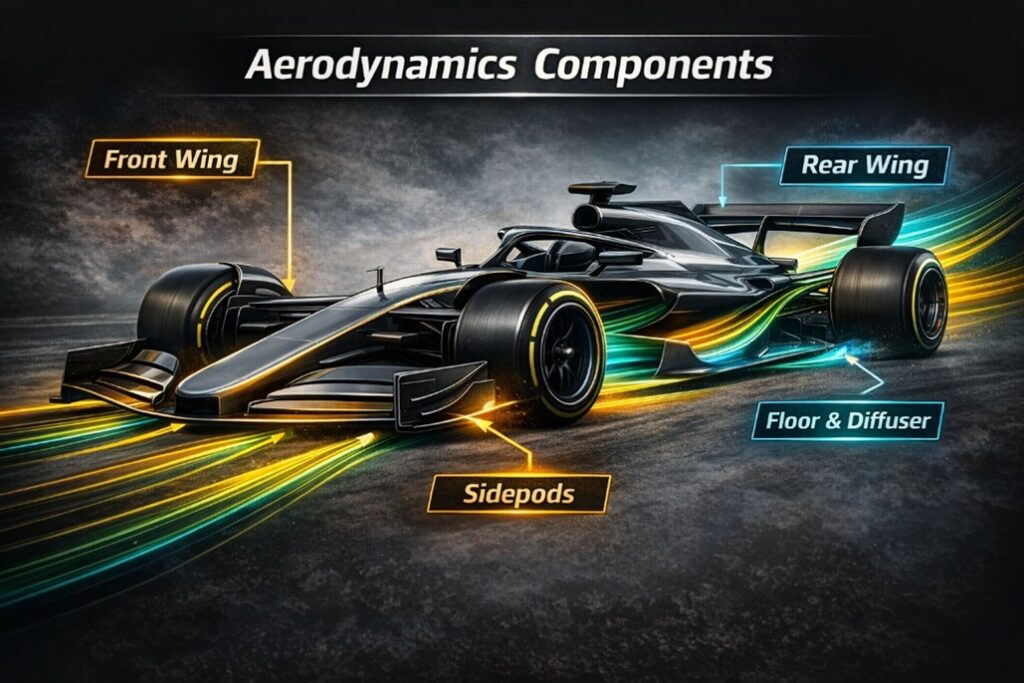
Front Wing
The front wing is the first surface that interacts with the air. It generates front downforce and directs airflow toward the rest of the car. Its design determines how cleanly air reaches the floor, sidepods, and rear wing.
Rear Wing
The rear wing generates downforce at the back of the car and provides high-speed stability. It also produces drag, so engineers adjust its angle depending on the circuit.
The rear wing uses airflow to push the back of the car downward.
This increases the vertical load on the rear tires, which improves:
- traction during acceleration
- grip at corner exit
- high speed stability
- braking balance
In simple words, it helps keep the rear tires planted on the track.
The rear wing gives downforce, but it also increases aerodynamic drag.
That means engineers must always make a tradeoff:
- more rear wing=more grip and stability
- less rear wing=more top speed but less rear grip
That is why rear wing setups changes depending on the circuit.
Floor and Ground Effect
The floor is the most efficient aerodynamic component. It accelerates airflow underneath the car, creating a low pressure region that pulls the car downward. This phenomenon, known as ground effect, generates large amounts of downforce with relatively low drag.
Diffuser
Located at the rear underside, the diffuser expands the airflow coming from the floor. This helps maintain low pressure under the car and enhances overall downforce. It is one of the most efficient ways to generate grip.
Sidepods and Flow Management
Sidepods shape and guide airflow toward the rear of the car while also housing cooling systems. Their geometry plays a critical role in maintaining clean air flow to the diffuser and rear wing.
DRS: When Aerodynamics Become a tool for Overtaking
The Drag Reduction System (DRS) is a movable flap on the rear wing that reduces drag on the straights.
When activated:
- the wing angle decreases
- airflow become smoother
- drag is reduced
This increases top speed, allowing drivers to overtake. However, it also reduces downforce, which is why DRS can only be used in specific conditions.
DRS highlights an important concept: aerodynamics is always a trade -off between grip and speed
The Danger of Poor Aerodynamics
While good aerodynamics improve performance, poor aerodynamics can be dangerous. At Formula 1 speeds, airflow generates forces strong enough to significantly affect vehicle behavior.
Loss of Grip
If aerodynamics forces are inconsistent, the car may lose downforce suddenly. This reduces tire and can lead to loss of control, especially at high speed.
Aerodynamic Imbalance
The car must maintain balance between front and rear downforce. If this balance is disturbed:
- too little front downforce -> understeer
- too little rear downforce -> oversteer
At high speed, even small imbalances can make the car unstable.
Sensitivity to Motion
A Formula 1 car is constantly changing:
- braking causes forward pitch
- acceleration shifts weight rearward
- cornering introduces yaw
If the aerodynamic design is not stable under these conditions, the car may lose grip unexpectedly.
Aerodynamic Lift
In extreme cases, poor airflow can generate lift instead of downforce. This reduces the load on the tires and can lead to severe instability. Since aerodynamic forces increase with speed, this effect becomes more dangerous at higher velocities.
Aerodynamics as a Safety System
It is easy to think of aerodynamics as a performance toll, but it is equally a safety system. Engineers do not aim for maximum downforce; they aim for predictable and stable behavior. A car that produces slightly less downforce but maintains it consistently is safer and easier to control than a car with higher but unstable aerodynamic forces.
Driver confidence depends heavily on this stability. At speed exceeding 186 mph (300 km/h), even a small loss of predictability can have serious consequences.
Senna’s Concerns About Aerodynamics
In the final stage of his career, Ayrton Senna raised concerns about the stability of Formula 1 cars following regulatory changes that removed electronic control systems. Without these systems, aerodynamics performance became more sensitive to ride height and vehicle motion, making the cars less predictable at high speed. His observations highlight a critical engineering reality; it is not enough to generate high downforce, that downforce must remain stable and consistent under all conditions. When aerodynamics becomes unpredictable, the car becomes not only slower, but significantly more dangerous.
Conclusion
Formula 1 aerodynamics is one of the most advanced applications of fluid dynamics in engineering. It transforms air into a tool that defines how fast, how stable, and how safe a car can be. From the front wing to the diffuser, every component plays a role in shaping airflow and controlling forces. Together, they create a system that allows drivers to push the limits of speed and precision. But aerodynamics is not just about performance. It is about maintaining control in an environment where small changes can have massive effects. Poor aerodynamic behavior can lead to instability and accidents, while well-designated aerodynamics provide the grip and predictability needed for high- speed racing.
In Formula 1, aerodynamics is not just what makes cars fast, it is what makes that speed possible.