
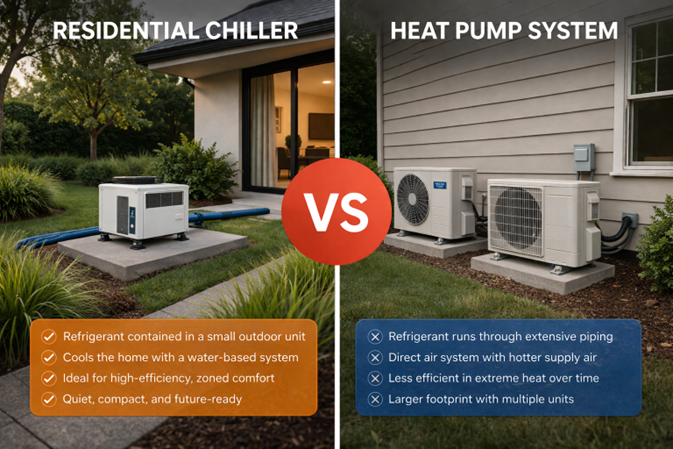
For Decades, Direct Expansion (DX) systems, such as split units packaged HVAC systems, have dominated residential applications due to their simplicity and lower upfront cost. However, the landscape is changing rapidly. Today, chilled water systems are emerging as a superior solution for modern residential projects, especially in high end homes, multifamily developments and energy conscious designs.
Superior Energy Efficiency
Chiller systems distribute chilled water throughout the building to the water cooled air handling units, instead of relying on refrigerant lines directly connected to indoor units.
This offers key efficiency advantages:
- Better performance under partial load conditions, which is where residential systems operate most of the time.
- In contrast, DX system cycle on and off frequently, leading to: energy losses, reduced equipment lifespan and lower seasonal efficiency.
Improved Comfort and Temperature Control
Chilled Water systems provide:
- More stable indoor temperatures
- Better humidity control
- Reduced temperature fluctuations compared to DX systems
DX systems often:
- Create hot and cold spots
- Struggle with humidity in humid climates
Chiller systems deliver a more consistent and premium comfort experience, similar to what is found in luxury hotels and commercial buildings.
Scalability and Zoning Flexibility
AS residential projects become more complex (smart homes, larger floor areas, multizone living), chiller systems shine:
- Easy integration with fan coil units (FCUs) or air handlers
- Independent zoning without multiple outdoors units
- Ideal for large homes, multifamily buildings, mixed use developments
DX systems require:
- Multiple condensers
- Complex refrigerant piping
- Limited flexibility for expansion
Maintenance and Longevity
Chiller system typically:
- Have larger service life
- Require more predictable maintenance
- Offer easier troubleshooting in centralized systems
DX systems:
- Have distributed components (many failure points)
- Often require full system replacement instead of repair
The use of R-410A Gas
Both systems use R-410A gas, but this refrigerant is just contained in chiller systems, on the other hand, this refrigerant gas is distributed in direct expansion systems:
In a DX system:
- Refrigerant travels through the entire house
- Long refrigerant piping connects outdoor and indoor units
- Every Evaporator coil contains refrigerant
In a chiller system:
- Refrigerant is contained in the chiller unit only
- The building is cooled using water (hydronic loop) instead of refrigerant
This gives the following advantages:
- Lower risk of refrigerant leaks inside the home
- Much easier maintenance and servicing
- Reduced environmental exposure